01
Start with the economic problem
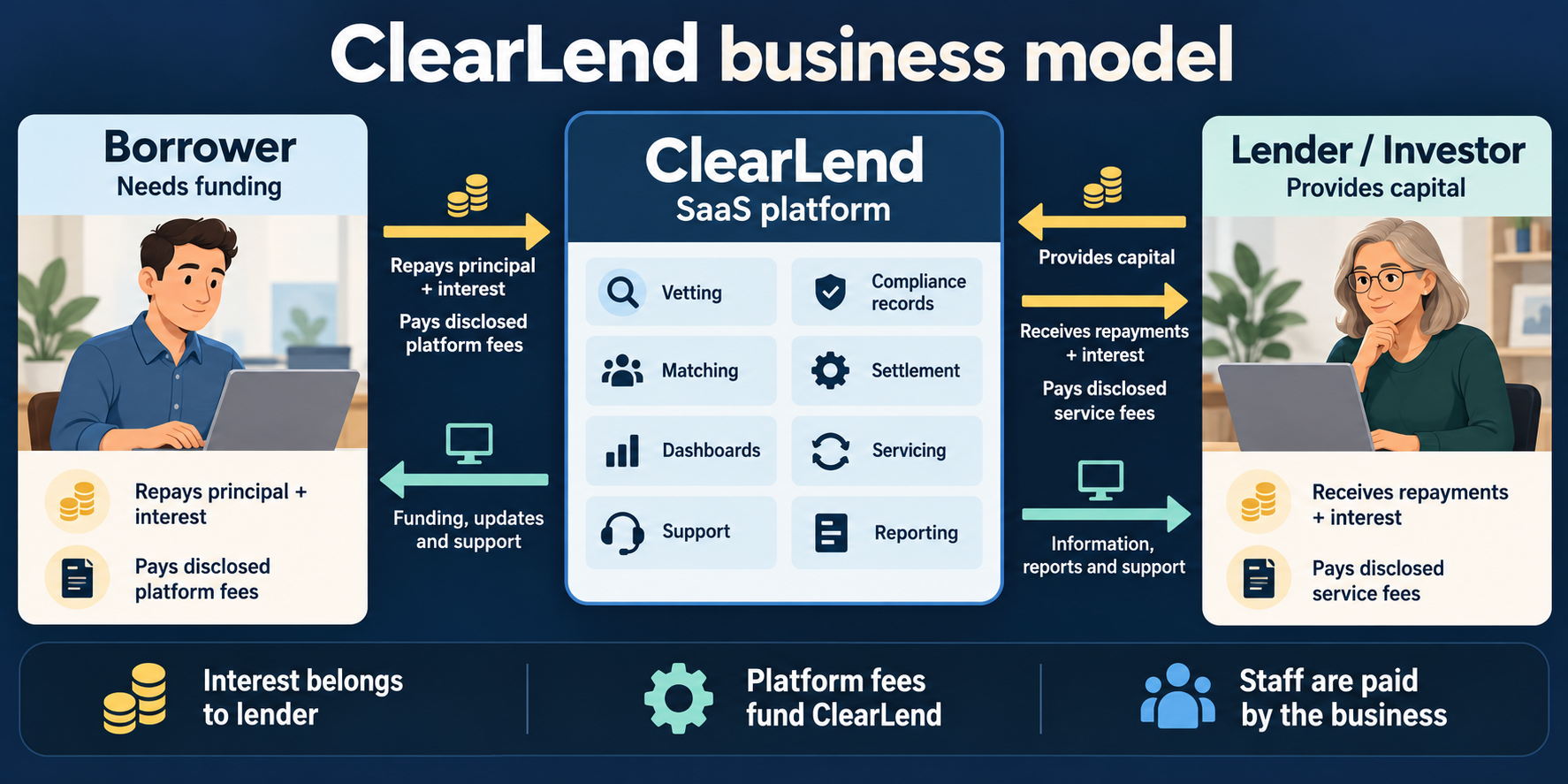
Every business needs a reason to exist and a way to pay for the work it performs. A customer buys because a product solves a problem. A seller provides the product because selling it creates a return. ClearLend follows the same pattern, but the product is a managed lending marketplace delivered as SaaS. A borrower needs access to funding. A lender has capital and wants a potential return. ClearLend provides the software, checks, records, support, matching, payment operations, and reporting that allow those two sides to work together. The platform earns fees for providing that service. This is the commercial story we want a reader to understand before we discuss technology. ClearLend is not presented as a bank that automatically owns the loans. It is a fictional platform that connects parties and operates the workflow around them. If the platform later decided to lend its own money, that would be a different business model with different risks, capital requirements, and regulation.
- Borrower value: access to a clear funding process and a manageable repayment plan.
- Lender value: access to opportunities, product tools, portfolio information, and servicing.
- ClearLend value: recurring SaaS and transaction revenue for operating the marketplace.
- Employee value: meaningful work, stable employment, and incentives tied to quality rather than unsafe volume.
02
The borrower pays for access to useful funding
The borrower joins because they have a real need: a wedding, home renovation, education, vehicle, business equipment, a planned project, or a short-term cash-flow problem. They are not buying a dashboard. They are buying access to a process that may help them obtain money on terms they can understand and manage. ClearLend should therefore make the borrower journey useful before any fee is charged. Registration, product browsing, and an initial eligibility explanation can be free. The borrower can compare amount, term, interest rate, total repayment, payment schedule, evidence requirements, and important assumptions. The borrower should not have to pay repeatedly for applications that never become loans. A completion or arrangement fee may be charged when a loan is accepted or funded, but it must be shown before commitment and included in the total cost. The borrower pays interest to the lender because the lender provides the capital. The borrower may also pay a platform fee for the service ClearLend provides. Those two amounts must be shown separately so the borrower can see who receives what. The long-term benefit to the borrower is not guaranteed profit. It is access to capital that may help them complete something valuable, together with a clear record of what they owe and what to do next.
- Free or low-cost registration and product browsing.
- Clear total repayment, not only an attractive headline interest rate.
- A visible credit limit and application status.
- Separate lines for lender interest and ClearLend platform charges.
- Support when evidence, payments, or circumstances change.
03
The lender earns a potential return on available capital
The lender or investor has money available and wants it to produce a potential return. They may be an individual, an investment business, or an organisation with a lending fund. The lender creates a product with an amount, term, interest rate, availability, eligibility criteria, evidence requirements, and other terms. ClearLend gives the lender tools to publish, pause, edit, retire, and monitor those products. The lender then reviews opportunities, records commitments, and follows repayments. The lender’s return is not simply the advertised interest rate. It is affected by fees, unused capacity, missed payments, defaults, recoveries, tax, and the time capital remains outstanding. The dashboard must therefore show gross interest, platform fees, outstanding balance, received repayments, expected repayments, and net return as separate concepts. ClearLend can charge the lender a service fee, a servicing fee, a product subscription, or a settlement fee. The fee model should be easy to understand and should not make the lender search through terms to discover that the return is lower than the headline rate. The lender pays because ClearLend reduces the administration required to create products, review cases, track commitments, manage payments, answer questions, and produce portfolio information. The platform should never describe a potential return as guaranteed income.
- Create products with clear terms and eligibility.
- See applications, commitments, active loans, and repayments.
- Understand gross return, fees, possible losses, and net return.
- Receive product, payment, and exception notifications.
- Use portfolio reports instead of maintaining separate spreadsheets.
04
ClearLend earns revenue by providing the service around lending
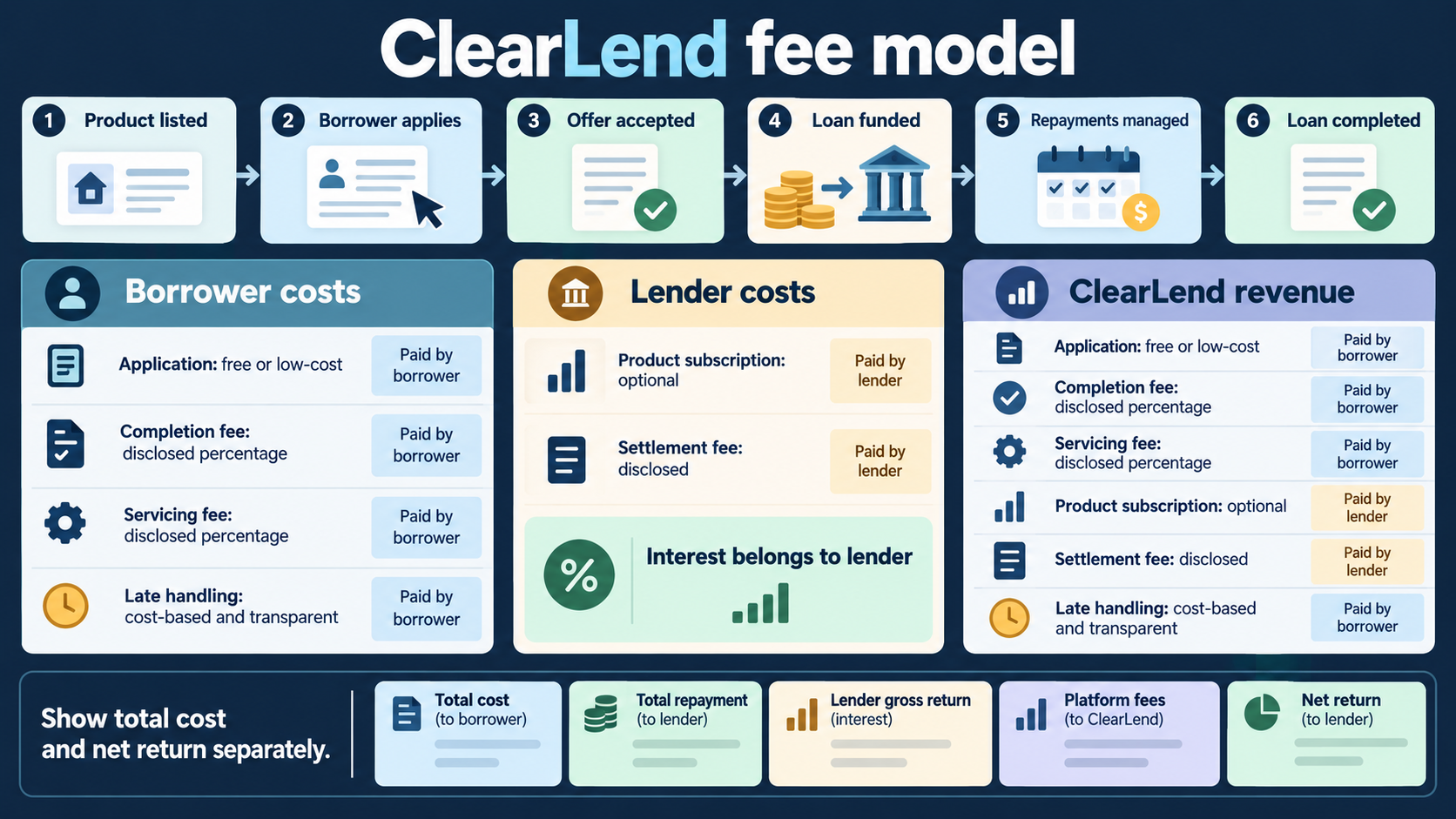
ClearLend is the SaaS business. Its revenue should come from the work it performs, not from confusing the borrower about the cost of credit. The platform supplies onboarding, vetting workflows, product management, application processing, matching, notifications, support, compliance records, settlement orchestration, servicing, reporting, and the software infrastructure that connects them. A simple first model can combine a completion fee with a lender servicing fee. Optional subscriptions can provide additional product capacity, analytics, exports, or integrations for lenders who need them. A settlement fee can cover payment and reconciliation operations. A borrower application can be free or low-cost, with the main fee charged when the platform has delivered a funded loan. The platform should keep interest belonging to the lender separate from fees belonging to ClearLend. It should also show staff costs, technology costs, payment-provider costs, and support costs as business expenses rather than hidden deductions from somebody else’s return. This makes the model easier to explain and gives the business a reason to keep customers successful: ClearLend earns when products are used, loans are completed, payments are managed, and customers trust the service over time.
- Completion or origination fee when a loan is funded.
- Lender servicing fee for portfolio and repayment administration.
- Optional lender subscription for advanced tools.
- Settlement or payment-operation fee where clearly disclosed.
- Enterprise or integration pricing for larger partners.
05
Use a simple fee catalogue
A reader should be able to look at one table and understand every possible charge. The exact rates in a real product would require legal, regulatory, tax, and commercial review, so this series uses labels and illustrative percentages rather than pretending to set a launch price. The important design decision is the ownership and timing of each charge. A fee has a payer, a reason, a trigger, an amount or formula, a refund rule, a disclosure location, and an accounting record. The same fee must appear consistently in the product page, offer, agreement, borrower statement, lender statement, and finance report. The platform should not quietly deduct a fee from repayments without explaining it. A small fee such as 0.05 percent may be easy to say, but on a large loan it may not cover vetting, support, compliance, hosting, payment integration, and servicing. It may work as a high-volume micro-fee, but the main revenue model needs to be tested against real operating costs.
- Application fee: free or low-cost, to avoid charging for unsuccessful applications.
- Completion fee: a disclosed percentage or fixed charge when a loan is funded.
- Servicing fee: a disclosed charge for repayment and portfolio administration.
- Product subscription: optional lender charge for advanced tools.
- Settlement fee: a disclosed cost for payment and reconciliation work.
- Late handling: cost-based and transparent, never the main revenue strategy.
public sealed record FeeRule(
    string Code,
    FeePayer Payer,
    FeeTrigger Trigger,
    decimal Rate,
    string Description,
    bool IsRefundable);

var completionFee = new FeeRule(
    "completion",
    FeePayer.Borrower,
    FeeTrigger.LoanFunded,
    0.01m,
    "Platform fee for completing and administering the loan",
    false);
06
Show one loan through three different views
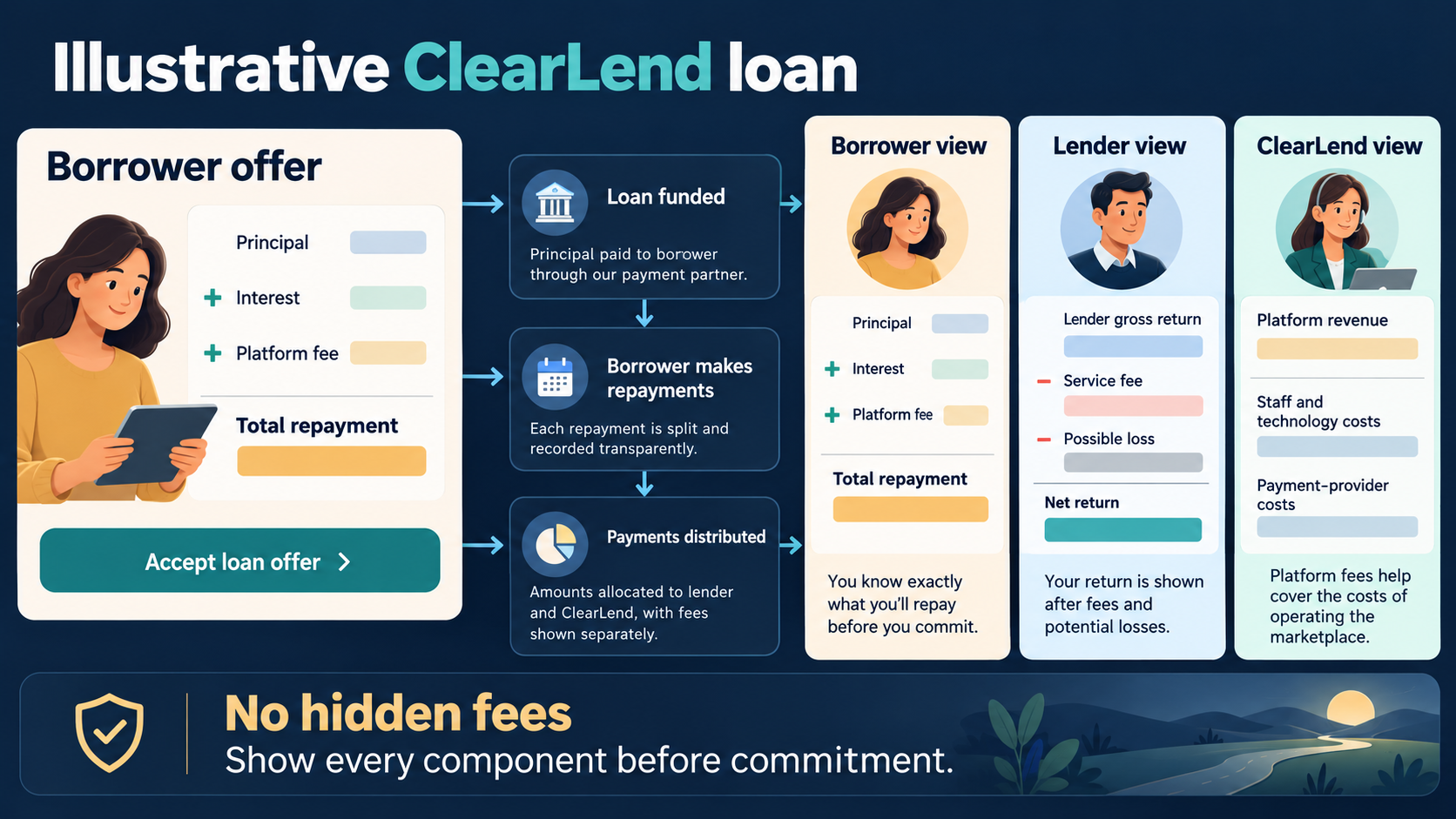
The same loan creates different information needs. The borrower wants to know the total cost and the next payment. The lender wants to know gross interest, fees, risk, repayments, and net return. ClearLend wants to know platform revenue, payment-provider costs, staff costs, reconciliation state, and whether the service is producing the intended outcome. A good design does not hide these differences. It stores the shared financial events once and produces authorised views for each role. An accepted offer creates terms. A funding event records that money was confirmed. A repayment is allocated to a loan. A fee is recorded against its payer and trigger. A correction creates an adjustment rather than overwriting the original. This is both a commercial explanation and an architecture decision. If the business cannot show where a number came from, the dashboard is only decoration. The illustration below deliberately leaves amounts blank so readers focus on the separation of principal, interest, platform fee, service fee, possible loss, and operating cost.
- Borrower view: principal, interest, platform charges, total repayment, and schedule.
- Lender view: gross return, service fee, possible loss, repayments, and net return.
- ClearLend view: platform revenue, staff and technology costs, provider costs, and exceptions.
07
Pay employees for quality, not unsafe volume
The roles inside ClearLend do not all earn money per loan. Support staff, CRM reviewers, compliance staff, finance staff, and servicing teams are paid by the business. Their work creates value by reducing confusion, preventing loss, improving repayment, protecting records, and keeping customers. Their incentives matter. A support agent rewarded only for closing cases may close them too early. A reviewer rewarded only for approvals may approve unsuitable cases. A collections employee rewarded only for money recovered may treat a borrower unfairly. A compliance analyst rewarded only for clearing the queue may miss important evidence. Better measures combine timeliness with quality: correct decisions, documented reasons, successful resolution, accurate reconciliation, appropriate escalation, customer outcomes, repeat issues, and control effectiveness. ClearLend should make the safe behaviour easy to perform and easy to audit. The business owner can still measure cost and productivity, but those metrics must be balanced with customer and risk outcomes. This gives readers a realistic view of how software, people, and commercial incentives fit together.
- Support: resolution quality, correct escalation, response time, and reopened-case rate.
- CRM: evidence quality, decision consistency, turnaround, and complaint outcomes.
- Compliance: control completion, traceability, repeat issues, and timely escalation.
- Finance: reconciliation accuracy, exception ageing, and correction quality.
- Servicing: accurate schedules, respectful contact, arrangements, and closure quality.
08
Protect the boundaries of the business model
The commercial model must not encourage ClearLend to profit from harm. The platform should not hide fees, describe uncertain returns as guaranteed, reward people for approving more borrowing, or make late fees the centre of the revenue strategy. Borrowers need clear cost information before commitment. Lenders need a fair description of potential return after fees, defaults, and taxation. The business needs to understand what happens if a payment provider fails, a product is paused, a lender leaves, or the platform enters a wind-down process. These are not only compliance questions. They are product and architecture questions. The fee catalogue needs versioning. Offers need to preserve the terms shown at the time. Payment and settlement states need to distinguish pending, completed, failed, reversed, and unknown. Reports need to show the source of each figure. Audit records need to preserve decisions and changes. This phase gives later requirements work a commercial boundary: build the workflow that creates value, record the events that prove it, and make the cost visible to the person who pays it.
- No hidden fee deductions.
- No guaranteed return language.
- No approval or collections incentive that rewards unsafe behaviour.
- No overwriting of financial history.
- No business rule that depends on one unverified payment response.
09
What Phase 1 gives the engineer
At the end of this phase, the team has more than a slogan about a lending marketplace. It has a commercial model that can be turned into requirements and code. We know why a borrower joins, why a lender lists a product, what ClearLend operates, how platform revenue is created, which fees need disclosure, how employees should be measured, and which boundaries protect customers. The next phase can turn this model into functional and non-functional requirements: fee rules, product states, offer terms, payment events, role permissions, statements, notifications, audit records, and reporting. The goal is not to predict every commercial decision. The goal is to give the application a coherent economic story so later technical decisions are made in service of a real product.
- Role-by-role value proposition.
- Borrower, lender, and platform money flows.
- A simple fee catalogue and fee-rule model.
- Illustrative statements and dashboard measures.
- Commercial boundaries for responsible implementation.