Understand the business
Map borrowers, lenders, products, applications, decisions, finance, servicing and operations before deciding on services.
Mentoring series · Microservices master class
Follow fictional people as they use ClearLend. Each chapter explains their goal, a possible design choice, its cost and the result a person should see. We teach with words and diagrams.
Stage 1 available · Stages 2–12 coming soon · Design lessons only
01 / The reason
The original ClearLend series chose a layered modular monolith. That was a sensible design: one deployable application is easier to understand, transact, debug and operate while a product is still being discovered.
This new master class explores the point at which meaningful independence could justify a distributed system. Applications and lender products may change at different speeds. Finance needs stricter controls than product browsing. Notifications and reporting should fail without stopping a borrower from saving a draft. Different teams may need to release and scale their capabilities independently.
Microservices are not small APIs. They are independently manageable business capabilities with owned data, explicit contracts and operational responsibility.
We will also show the cost: network failures, eventual consistency, duplicate messages, contract evolution, cross-service security, more deployment paths and harder debugging. If two services become permanently chatty or cannot change independently, we will consider merging them.
02 / A fresh design
The earlier project supplies the fictional business setting. This course shows how a team could design microservices from the beginning. It is a website book, not a ClearLend application.
Map borrowers, lenders, products, applications, decisions, finance, servicing and operations before deciding on services.
Draw what a borrower would see and how proposed parts would respond.
Show when a database, message broker, cache or cluster would help and what it would cost.
Before Stage 1 / The dependency order
A dependency is something we need before we can make the next decision. We cannot choose a database for a product before we know who owns the published terms and what Amina needs to see.
After the journey is clear, discuss what tools a real team might need and what each would add. The course does not install or run those tools.
03 / Possible architecture
This diagram is a proposal to test against later journeys. It does not show a system we have built or deployed. We may use fewer services.
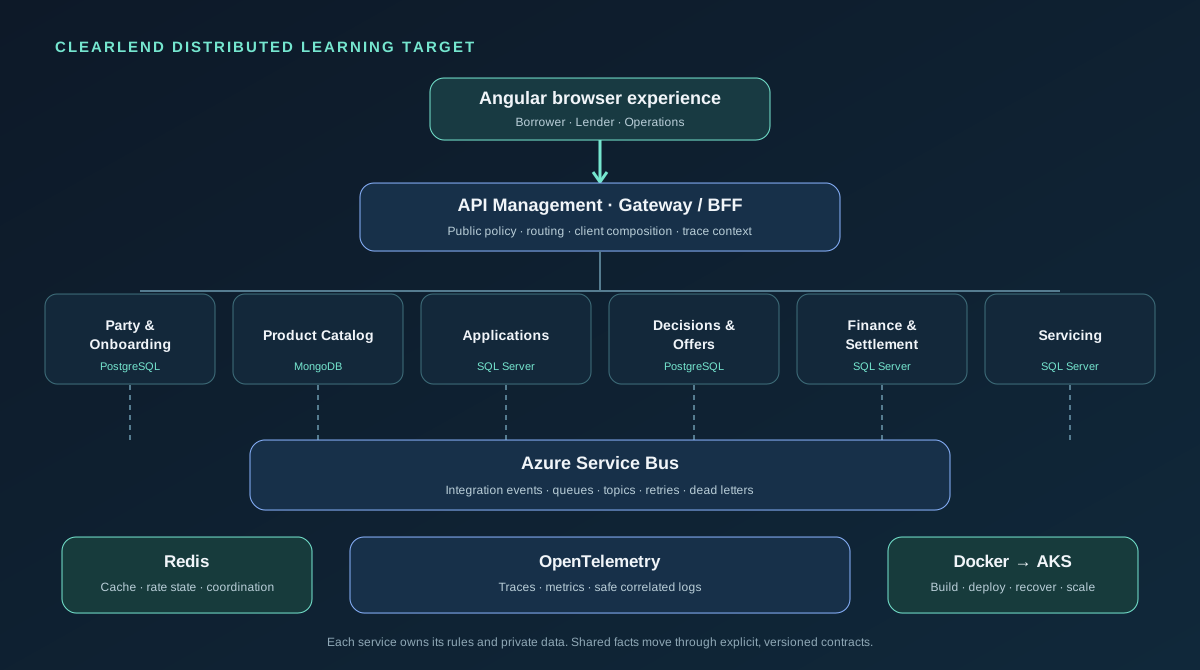
A proposed service should have a clear answer to what it owns.
Show which changes would succeed together and which could finish later.
Show what a person would see if another part were unavailable.
Explain what evidence a support person would need without exposing private data.
04 / Possible service ownership
These are proposed boundaries. The tools and data stores shown below are questions for later stages, not decisions already implemented.
Owns: Borrower and lender profiles, vetting state and eligibility snapshots.
Why: Keeps one official answer about a person and their checks.
Owns: Versioned lender products, publication state and eligibility descriptions.
Why: Keeps the official published terms separate from a lender’s draft.
Owns: Drafts, submissions, requested amounts, ownership and concurrency.
Why: Keeps the borrower’s request and its changes in one place.
Owns: Review cases, reasons, exact offer terms, expiry and acceptance.
Why: Records why a decision was made and which offer was accepted.
Owns: Commitments, payment attempts, reconciliation and financial entries.
Why: Tracks money movement and explains corrections.
Owns: Active loans, schedules, balances, arrangements and closure.
Why: Tracks what happens after a loan becomes active.
Owns: Delivery requests, templates, preferences, attempts and outcomes.
Why: Delivery failures must remain independent from lending decisions.
Owns: Purpose-built support, compliance and owner dashboards.
Why: Gives support staff useful views without changing the official records.
05 / Possible technology
These are topics we may explain in later chapters. A named person's problem should give each tool a reason. None has been added to a ClearLend application.
Discuss where business APIs and background work might belong.
Discuss how a browser journey could avoid depending on internal service details.
Discuss when transactional data might need a relational store.
Compare another relational option and explain why a team might choose it.
Discuss whether changing product structures justify a document store.
Discuss faster reads alongside the risk of showing old information.
Explain delayed work, messages and duplicate delivery through a person’s journey.
Explain how a team could plan a repeatable local setup.
Explain what evidence could trace a delayed borrower journey.
Explain how a team might run and recover containers on Azure.
Explain how a team might plan resources and protect secrets.
Explain how a team could check and release changes safely.
If product browsing became slow, could a cache help Amina? We would first ask why it is slow and explain how old product information could affect her. Redis is a teaching topic here.
06 / The first journey
This is a fictional story used to explain design choices. Stage 1 teaches Amina's product-reading question. Later chapters will discuss the other steps. None is a working feature.
07 / Twelve teaching stages
We write and review one chapter at a time. Stage 1 is ready to read.
Chapter availability: Stage 1 is available. Stages 2–12 are Coming soon and do not open pages.
Follow Amina’s product-reading story and decide who should own the published terms.
Follow a borrower who wants to save a draft and decide where each rule belongs.
Draw a proposed request path through an entry point, Catalog and Applications.
Learn what an image is and how a team could plan a local container setup.
Compare SQL Server, PostgreSQL and MongoDB for different service needs.
Design synchronous APIs, asynchronous events and gateway policy.
Explain how a team could recover delayed, duplicated and partly completed work.
Improve speed and safety while keeping failure bounded and visible.
Learn how a real team could check contracts, workflows and user journeys.
Understand raw workload resources before introducing packaging abstractions.
Learn what AKS, identity, networking, secrets and managed services would need.
Explore releases, recovery, service goals, performance and cost.
08 / Where we are
Stage 1 explains Amina's product journey and a proposed ownership boundary with words and diagrams. Stages 2–12 are still being prepared. Each later chapter will begin with a teaching plan for review.
No ClearLend microservices application, API, database, container or Azure platform exists. The diagrams show proposals.
Follow the lessons
The original ClearLend series explains the product and layered architecture. This new master class follows the same fictional marketplace into service ownership, messaging, containers, Kubernetes and Azure operations.